

The penis thickness describes how wide the penis shaft is. In studies and in everyday life, it is usually given as a circumference around the shaft, less often than diameter. A much quoted Systematic review With data from up to 15 521 men, an average circumference of 9.31 centimeters in the limp and 11.66 centimeters in the erect state was found. Such average values describe groups and not an individual norm, because healthy men also differ significantly in penis thickness.
Here’s what these numbers mean, how to measure penis thickness without calculating, what factors affect the outcome, and what research says about whether circumcision changes thickness.
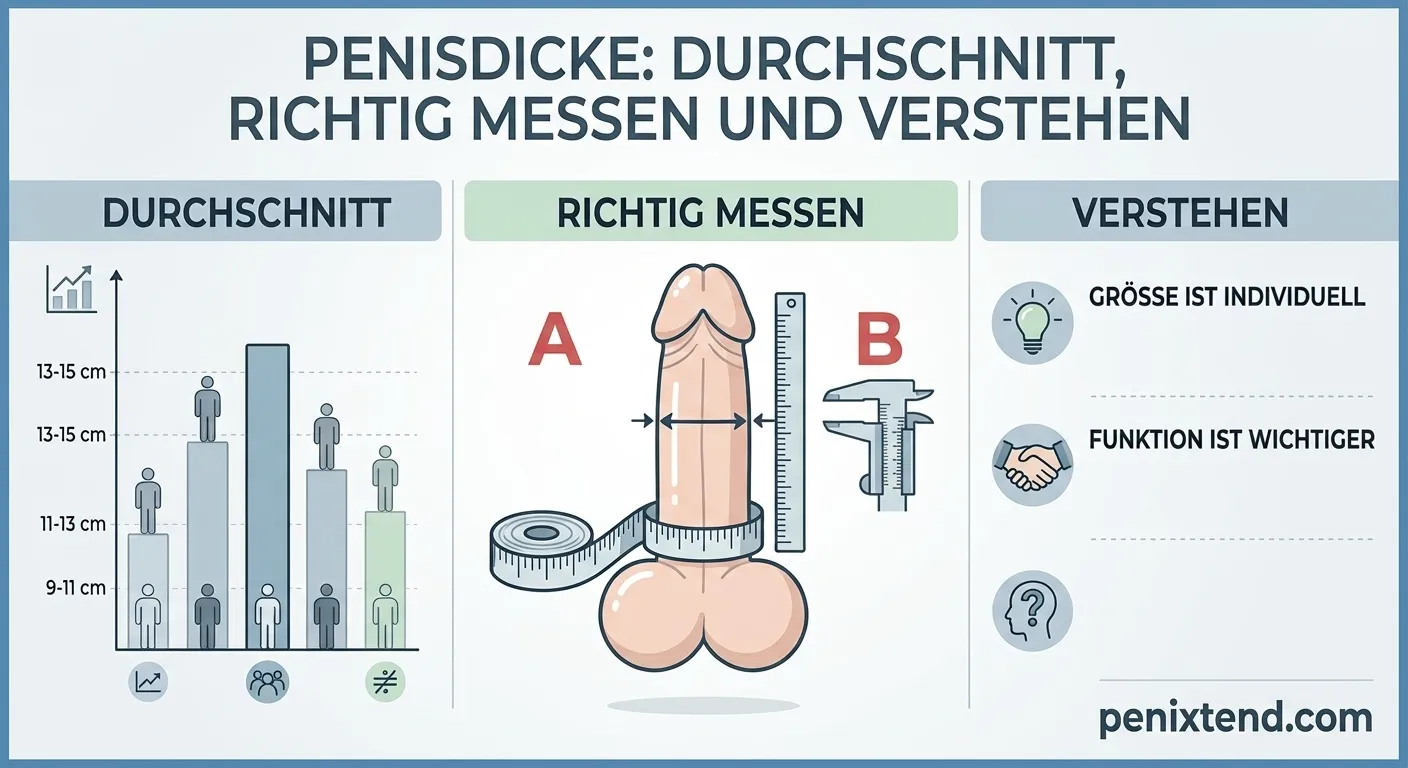
Penis thickness denotes the transverse extent of the penis shaft. It can be indicated in two ways: as Penis circumference, so the distance once around the shaft, or as Penis diameterThe width from one side to the other.
The cross section of a penis is not perfectly round. The diameter therefore corresponds only approximately to the circumference divided by the circle number Pi. Scientific papers usually specify the circumference because it can be easily recorded with a soft tape measure. When figures are mentioned in this article, the scope is therefore usually meant.
The thickness is only a part of the penis size next to the length. Both also depend on whether the penis is measured limp or erect.
In a systematic evaluation of clinically measured data, the average penis thickness, indicated as circumference, was 9.31 centimeters in the limp and 11.66 centimeters in the erect state. Both values are averages of a group and not a specification of how thick a penis should be.
The figures come from the work of David Veale and colleagues, published in 2015 in the journal BJU International. The team evaluated 17 studies in which medical professionals had measured according to a standard procedure. Men aged 17 and over were included. Samples with congenital or acquired changes of the penis, previous operations, erectile dysfunction or the complaint about a too small penis were excluded.
Average penis size according to Veale and colleagues (2015)
| Condition | Average | Standard deviation | Men in evaluation | Calculative range (two standard deviations) |
| Slack | 9,31 cm | 0,90 cm | 9 407 | Approximately 7,5 to 11,1 cm |
| Erect | 11,66 cm | 1,10 cm | 381 | about 9.5 to 13.9 cm |
The standard deviation shows how strongly the values scatter around the mean value. With a normal distribution, about two-thirds of men are within a standard deviation around the mean and about 95 percent are within two standard deviations. The range in the table is calculated from the published values and not a limit of the study. The authors themselves created their diagrams from simulated normal distributions.
How resilient are the values? The data is wider for limp measurements than for erect ones. The erect size is based on only 381 men, and only a few erect measurements were performed in a clinical setting. The authors also point out that more confident men could be measured voluntarily, which can distort the averages somewhat. Self-declarations from surveys are considered more susceptible to distortion and did not flow into this work.
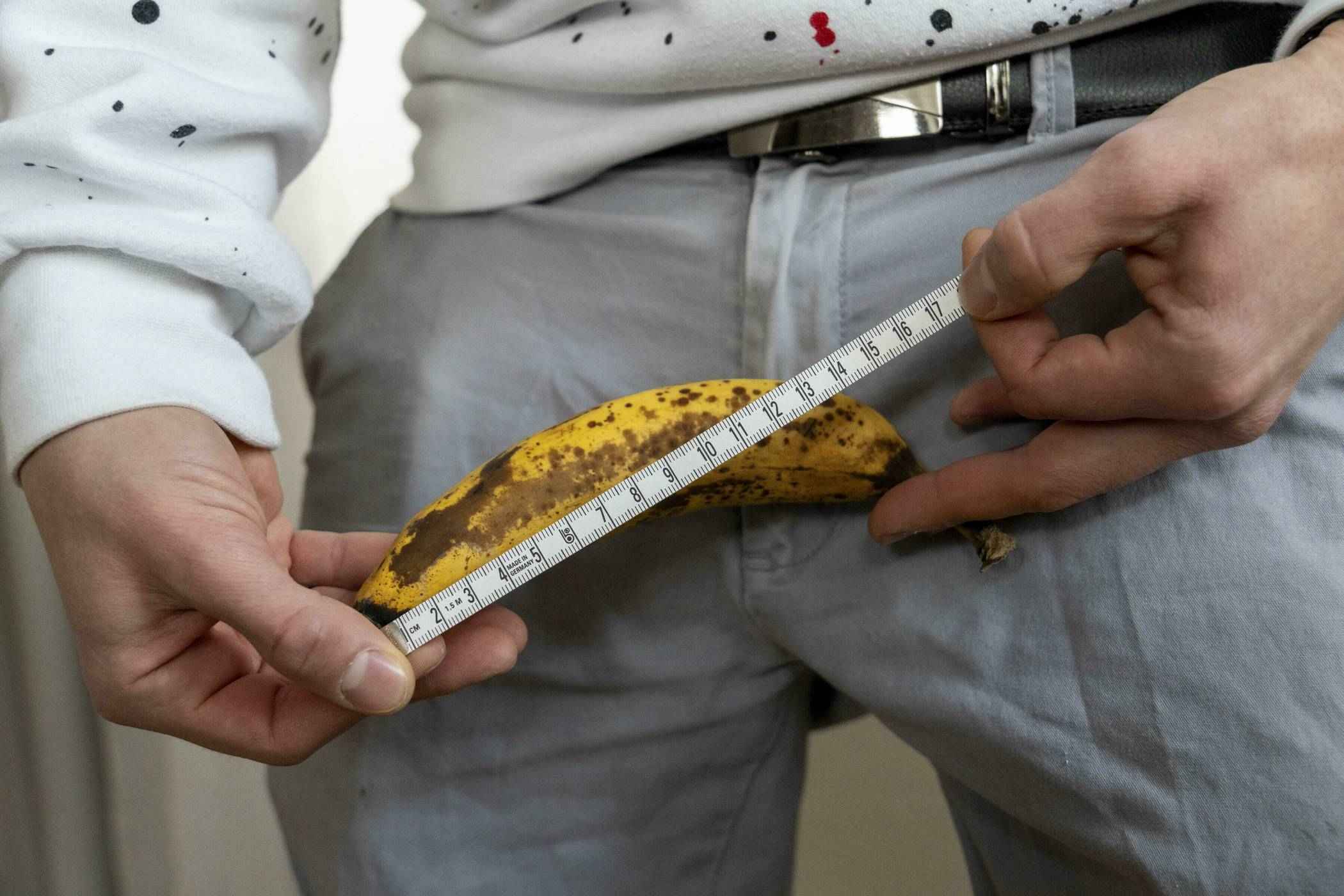
Measure penis thickness succeeds best with a soft tape measure, which you put around the shaft without pressure. It is important to always measure in the same state, at the same point and with the same method, because otherwise values cannot be compared.
This is how you proceed in five steps:
Don't check constantly. Frequent control can increase uncertainty rather than resolve it.
In the flaccid state, the circumference fluctuates more because temperature, relaxation and blood circulation affect it. This is shown by clinical experience. A warm, relaxed moment delivers more reliable values than a cold shower or stress. Flaccid readings are therefore good for comparing yourself over time, but less good for comparing with other men.
The erect measurement is usually better comparable, because the penis is then in a clearly defined state. Miss in a naturally created erection. You do not have to force anything and you should neither pull nor stretch nor manipulate vigorously. The firmness of an erection can vary depending on the arousal and situation, so several measurements help. Pain, a clear curvature or palpable hardening are a reason to seek medical advice.

Penis thickness is the generic term. Scope and diameter are two ways of expressing them. Therefore, you should only compare numbers with numbers of the same kind.
| Term | Significance | Typical measurement | Note: |
| Penile thickness | Generic term for the width of the shaft | Indication as circumference or diameter | Is often used in everyday life fuzzy |
| Penis circumference | Distance once around the shaft | Measurement tape at the center or base | In studies, the usual indication |
| Penis diameter | Width of the shaft from one side to the other | Measuring slide or calculation from the circumference | Only approximately, since the cross section is not exactly round |
An example shows the difference: a circumference of 11 centimeters does not mean that the penis is 11 centimeters thick. The diameter is then only about one third thereof.
The measured penis thickness depends on the anatomy, the condition of the penis and the measurement method. Many differences between two measured values are not caused by a real change, but by the circumstances of the measurement.
For age, body weight and origin, the data on penis thickness is limited. This article therefore makes no statements about this.
A penis circumference within the above study range is statistically considered typical. If your value is below or above, this is not yet a disease. From individual measured values, a medical finding cannot be automatically concluded.
The authors of the review note that men with concerns about penis size are often in the normal range. The Guideline of the European Association of Urology Penis size deviations include an accurate measurement and a detailed history as part of the assessment. It also recommends referring men with normal penis size who want enlargement for psychological clarification of a possible body dysmorphic disorder.
So you do not have to assume that you are missing something if you find yourself in the lower or upper range when measuring.
According to the sources considered here, there is no reliable evidence that circumcision changes the actual penis thickness. However, the appearance can change, and that can affect the perceived thickness. Statements about appearance should be distinguished from statements about actual anatomical changes.
In the case of circumcision, the foreskin is completely or partially removed. The cavernous bodies that fill the shaft during an erection are not affected during this procedure.
Visibly, especially the glans, which is permanently exposed in the case of a circumcised penis, and the skin of the shaft, which can fit tighter. Depending on the procedure, a scar line remains. These changes affect the appearance and feel of the skin, not automatically the dimensions of the shaft.
There is limited data on measurable changes. One Korean study 2 335 young men compared circumcised and uncircumcised participants and concluded that circumcision did not increase penis length. This work did not comment on the thickness. Studies that measure the extent before and after circumcision in adults are rare, according to the sources considered here. The evidence on thickness is therefore limited.
Both variants are normal anatomical expressions. Neither is fundamentally better or worse.
| Criterion | Circumcised penis | Uncircumcised penis |
| Definition | Foreskin completely or partially surgically removed | Foreskin present |
| Acorn | Is permanently free | Is covered by the foreskin and is usually exposed in the erect state |
| Appearance in a limp state | The shaft looks smoother, a scar line is possible | The foreskin may form an excess of skin at the top |
| Measurement note | Select the measurement point off the scar line | Selecting the measurement point away from the overhanging foreskin |
| Evidence on size | No reliable indication of changed length, limited to thickness data | Serves in studies as a comparison group |
There is significantly less research on penis thickness than on penis length. The situation can be summarised as follows:
You should seek medical advice if complaints or changes occur, and not because of a reading alone. These include:
Even if thoughts about penis size weigh heavily on you, a conversation with a urologist or a psychotherapeutic specialist can be useful.
A penis extender is a traction device that exerts pulling force on the penis over a longer period of time. For the decision for or against such a device, the penis thickness provides no answer that could be derived from the studies mentioned here. Claims that a tractor changes thickness should be classified as manufacturer information or marketing as long as they are not supported by independent studies. This article does not promise any change in penis thickness.
If you would like to inform yourself about train devices in principle, you will find background information in our article on PeniXtend penis stretcher and explanations on the page for Functionality. Check statements there critically and speak with a doctor in case of uncertainty.
PeniXtend is a train-based device for men who are interested in a non-surgical option for penis size concerns. All verified product information can be found on the page for PeniXtend Penis Extender. Instructions for handling the device are in the GuidancePractical tips can be found under ApplicationThere are answers to typical questions in the Frequent questions about PeniXtend.
Make your decision calmly and based on verified information. A product should fit your goals, and for complaints or uncertainty, medical advice is the better first step.
The thickness of the penis is the width of the penile shaft. It is usually given as the circumference around the shaft, less often than the diameter from one side to the other.
In a systematic review, the average penis circumference was 9.31 centimeters in the limp and 11.66 centimeters in the erect state. These are group averages and not a standard for the individual.
Place a soft tape measure without pressure in the center or base around the shaft, always in the same condition and in the same place. Multiple measurements and their mean are more meaningful than a single value.
Penis thickness is the generic term for the width of the shaft. The circumference is the distance once around the shaft, the diameter the width from one side to the other. A circumference of 11 centimeters corresponds to a diameter of about 3.5 centimeters.
A single reading says little about a finding, and healthy men show a wide range. In case of complaints or severe stress due to thoughts of penis size, medical advice is useful.
A reliable proof that a circumcision changes the actual penis thickness is not available according to the sources considered here. The appearance may change because the foreskin is missing and the glans are exposed.
Yes, the extent increases during an erection, how strong, is individually different. In the study data, the erect mean was around 2.3 centimeters above the limp value. However, both values come from different sample sizes and are only a rough indication.
Penis thickness is most reliably girthed, and averages from studies are landmarks, not norms. Anyone who measures should keep the state, measurement point and method constant and understand values as a range. A circumcision mainly changes the appearance, a proof of changed dimensions is missing. In the event of complaints or heavy burden, it is worth talking to a specialist. If you are interested in a non-operational option, you can PeniXtend product Watch in peace.
This article is for general information and does not replace medical advice.