One Circumcised penis is a penis in which the foreskin has been removed partially or completely surgically. This procedure is called circumcision or circumcision. The reasons for circumcision may be medical, religious, cultural or personal.
Many men want to know what benefits circumcision can have, how a circumcised penis differs from an uncircumcised one, and whether the procedure affects hygiene, sexual sensitivity, or health.
In this guide, you will learn why men get circumcised, what the potential benefits and risks are and what the healing is all about.
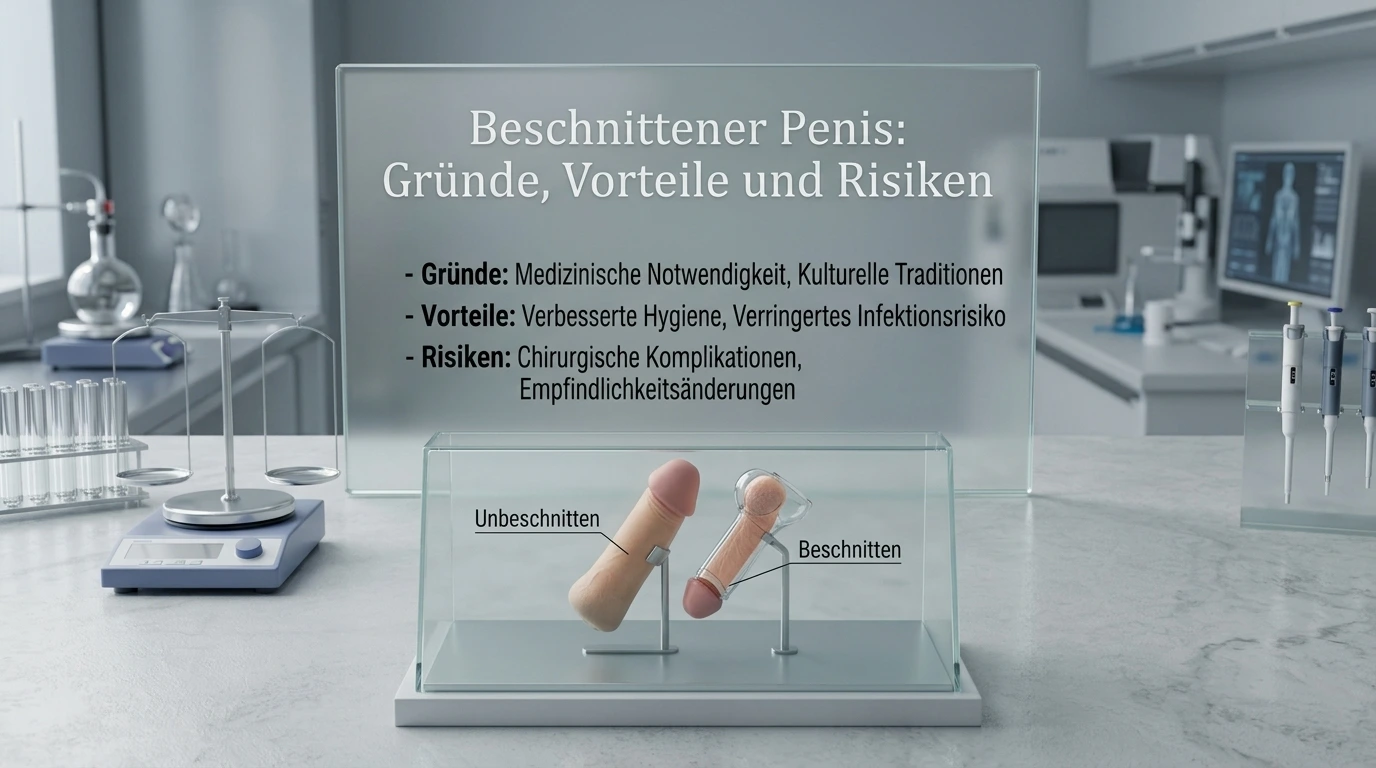
With a circumcised penis, the foreskin, which usually partially or completely covers the glans, was removed by a surgical procedure. After healing, the glans are permanently or largely exposed.
The appearance of a circumcised penis can be different. It depends, among other things, on how much foreskin was removed, which surgery method was used and how the wound healed.
Circumcision can occur in childhood or adulthood. In adults, for example, it can be considered medically for a pronounced constriction of the foreskin, recurrent inflammation or certain scarring.
However, not every foreskin constriction requires surgery. Which treatment is useful depends on the complaints and the individual medical situation. Further information on possible treatments is provided by the European Society of Urology (EAU).
The reasons for circumcision are different. While for some men medical complaints are in the foreground, for others religious, cultural or personal considerations play a role.
A common medical reason is phimosis. The foreskin is so narrow that it is difficult or impossible to retract. If this causes pain, problems urinating, or recurrent inflammation, treatment may be necessary.
Other possible medical reasons include:
Depending on the diagnosis, conservative treatment options may initially be considered. A doctor can assess whether circumcision is necessary or whether the foreskin can be obtained.
The NHS Circumcision Guide explains in which complaints the procedure is considered medically and which risks must be considered.
In various religious and cultural communities, circumcision has a long tradition. Especially in Judaism and Islam, it is of religious or cultural importance for many people.
In such cases, there must be no medical disease. Rather, the decision may be related to personal beliefs, family traditions or religious practices.
Some men choose circumcision for personal reasons. This can include individual ideas about appearance, experiences with recurrent foreskin complaints or personal hygiene preferences.
Such a decision should be well considered, since the removal of the foreskin is permanent and the procedure can cause possible complications.
The possible advantages of circumcision depend on the respective situation. For men with certain foreskin problems, the procedure may be an effective treatment. For men without complaints, however, circumcision is not automatically medically necessary.
Possible benefits include:
This possible protection is limited. Circumcision does not reliably prevent HIV or other sexually transmitted infections and does not replace condoms or other appropriate protective measures.
The CDC information on male circumcision and HIV prevention explain in which situations a lower risk was observed and the limits of this protection.
The health benefits should therefore always be assessed in the context of the individual situation and the possible risks.
The most important anatomical difference is the foreskin. In a circumcised man, it was partially or completely removed. In an uncircumcised man, it is still present and covers the glans partially or completely, depending on the anatomy.
| Characteristics | Circumcised penis | Uncircumcised penis |
|---|---|---|
| Foreskin | Partially or completely removed | Available |
| Acorn | Usually permanently exposed | May be partially or completely covered |
| Intimate hygiene | Cleaning without foreskin fold | Carefully withdraw the foreskin if this is easily possible |
| Skin mobility | Can change after the procedure | Foreskin enables additional skin mobility |
| Appearance | Depends on method and healing | Depends on the individual anatomy |
There is no uniform appearance that applies to all circumcised men. Also, the size of the penis is not reliably increased by a circumcision. If you have questions about penis size, you can find more information in our guide to the Average penis size.
A circumcised penis can make daily cleaning easier because there is no foreskin fold under which residue can accumulate.
However, this does not mean that an uncircumcised penis is fundamentally unhygienic. Even without circumcision, good intimate hygiene can be achieved by regular and gentle cleaning.
With an uncircumcised penis, the foreskin should only be retracted as far as possible without pain or resistance. It should never be withdrawn by force. After cleaning, it must be returned to its normal position.
For persistent pain, inflammation or problems with the withdrawal of the foreskin, a medical examination is useful.
Many men wonder if circumcision changes sexual sensation. A blanket answer is not possible, as the experiences can be individually different.
After the operation, the glans can initially be very sensitive. During healing, swelling, pain or a feeling of tension may also occur.
In the long term, the sensitivity of the glans and the mobility of the penile skin can change. How these changes affect the personal sexual experience is different.
Therefore, it cannot generally be said that a circumcised penis during sex is better or worse than an uncircumcised penis. Even from circumcision alone, no reliable statement about sexual performance can be derived.
Anyone who has questions about sensitivity, erection or sexuality before circumcision should discuss them with a qualified urologist.
Circumcision is a surgical procedure and can cause side effects or complications. The individual risks depend, among other things, on the state of health, the operation method and the follow-up care.
Possible risks are:
Rarely, further medical measures or re-operation may be necessary.
Before the procedure, a doctor should inform about the possible benefits, risks, alternatives and the expected course of healing. In the case of medical complaints, it should also be clarified whether treatment is possible without complete removal of the foreskin.
Further information on complications and follow-up can be found in NHS Circumcision Guide.
According to the UK Health Service NHS, healing after circumcision usually takes about four to six weeks. In some cases, it can take longer.
During the first one to two weeks, swelling, bruising and mild bleeding may occur. An increased sensitivity of the glans or a feeling of tension during an erection can also occur during the healing phase.
For a good wound healing, the following points are important:
For persistent or increasing pain, noticeable wound discharge, fever, heavier bleeding, or difficulty urinating, medical advice should be sought. If you are unable to urinate at all or you experience severe, non-relieving bleeding, immediate medical attention is required.
The full hints for recovery can be found at NHS: Circumcision.
This question cannot be answered in general terms. Both forms may be associated with normal function in healthy men.
Circumcision can be useful for certain medical problems and reduce some health risks. At the same time, it is a permanent surgical procedure that involves possible complications and changes in skin sensitivity.
Whether circumcision is useful therefore depends on medical circumstances, personal ideas and, if necessary, religious or cultural considerations.
There is no general reason to classify a circumcised man as healthier or more sexually capable than an uncircumcised man.
A circumcised penis is a penis in which the foreskin has been removed partially or completely surgically. After healing, the glans are permanently or largely exposed.
Possible reasons include pronounced foreskin constriction, recurrent inflammation, certain scarrings, and religious, cultural or personal considerations.
Some men choose circumcision for medical reasons, while others see religious traditions, personal beliefs, or individual preferences as crucial.
Depending on the situation, circumcision can treat certain foreskin problems, make cleaning easier and reduce the risk of some infections. However, it is not medically necessary for every man and does not provide complete protection against sexually transmitted infections.
Cleaning can be easier because there is no foreskin fold. An uncircumcised penis can also be kept hygienically clean with regular, gentle cleaning.
That cannot be said in general terms. Circumcision can change the sensitivity and mobility of the skin. How this affects the sexual experience is individually different.
Healing usually takes about four to six weeks, but can take longer. The exact duration depends on the individual healing course. Medical instructions on care and resumption of sexual activity should be followed.
The surgical removal of the foreskin is permanent. Reconstructive procedures can be considered in certain cases, but do not simply restore the original foreskin and do not guarantee a certain result. If interested, a specialized doctor should inform about possibilities and limits.
A circumcised penis differs from an uncircumcised penis mainly by the partial or complete removal of the foreskin. The reasons for circumcision range from medical complaints to religious, cultural and personal decisions.
Possible benefits include treating certain foreskin problems, easier cleaning, and reducing some risks of infection under certain conditions. At the same time, one should consider possible complications, changes in sensitivity and healing time.
Anyone considering circumcision for medical or personal reasons should be fully informed and, if necessary, consult a qualified urologist. Individual advice helps to realistically assess the benefits, risks and possible alternatives.